conventions have debuted special anthologies, but how many of them have given them all away for free to every member? Or had such a nice buffet outside the signing? (The Parmesan-stuffed artichokes were amazing!) Although it was far enough into the suburbs that I didn't make it to downtown Austin this trip, the Renaissance hotel was wonderful, and featured a perfect example of my theory of good convention bars - one that is perfectly placed in the center of everything, spacious, patio-equipped for the cancer stick aficionados, and visible from all parts of the lobby. Really, a good convention starts from the tone set by the bar, the World Fantasy doubly so. And my son loved the birds and bells suspended from the ceiling too.
But rapidly: Highlights for me included meeting with the very friendly Tim Holman and Devi Pillai of Orbit, getting to spend some real time with Morgan Burns of Borders Books (making his convention debut), finding a kindred spirit in discussing theories of science fiction with Donald Maass, whiling away several late nights in interesting discussions with Ted Chiang, bumping into Karen Miller at the internet kiosk, and talking fantasy with Gollancz/ Orion's Jo Fletcher.
 I was also overjoyed that I got to spend real time with old and dear friends - John Picacio, Chris Roberson, Allison Baker, Alan Beatts, Irene Gallo, Jen Heddle, Karen Jones, Joe McCabe, Jess Nevins (pictured with wife on left), David B. Coe - as well as with newer (and relatively newer) ones - Paolo Bacigalupi, Greg Manchess, Tim Akers, Deanna Hoak, to name only a few. I was honored to be on a panel about cover illustration with the likes of such giants as Gary Gianni, Charles Vess and John Jude Palencar - all very nice folk - and grateful that Irene Gallo, who was sitting in the audience and eminently more qualified to be on the panel than I, was a good sport about being roped in. And the Sharyn November-moderated panel, Will Somebody Please Explain This Book? was a riot - and a damn site better than a panel with that title had a right to be, largely due to Ms. November herself. People I got some but not enough time with include - but certainly aren't limited to - Alexis Glynn Latner, Marjorie M. Liu, Jay Caselberg, Jeff Vandermeer, Hal Duncan, and Graham Joyce. (And my own patient wife, Xin, who I saw maybe once the whole weekend.)
But working my way through the above list of shout outs and name drops - which is ludicrously long even as it is woefully incomplete - really makes me think about what I love about this business most - and that is being part of such a community of wonderful people. Every convention is an opportunity to meet up with dear friends from all over the world, even as it is an opportunity to make new ones, and every convention leaves me feeling regretful that for everyone I got to catch up with, there are two more people I wish I had. The longer I'm in this business, the more friends I make, and the more poignant this happy/sad feeling is, with the only solution I can think of being to extend WFC from a four day occasion to a month long event. (Just think about it.) There are just so many good people in our business...
...and speaking of good people, the skinnier, fuzzier, and somehow inexplicably younger looking John Meaney blew my mind with his demonstrations of NLP technique, and after the ten minute trance he put me in right before the awards banquet, I'll never look at my left arm the same way again. Cause that wasn't my conscious mind doing the lowering, I swear. John is one of the most interesting and intelligent people I know - really one of my favorite people in the world - and at a convention full of interesting and intelligent people that's saying something. Seeing him once a year is certainly not enough either, so, mate, I don't know what my wife is going to say about this, but you and Yvonne are invited to come live permanently in my guest room. You two don't eat much, right?
But WFC is a professional con, and on the professional side, I was also happy to see that not a single copy of Scott Mackay's Tides or Charles Coleman Finlay's The Prodigal Troll -which we donated to the tote bags - ended up on the returns table. There are always stacks of abandoned books at the end of the con where people have sorted through their bags and rejected the ones they don't want - but not a single copy of either was on the table all weekend that I saw. Not a one! (Provided they actually get read, and don't end up on eBay, I'd love it if readers would come here and tell me what they thought.)
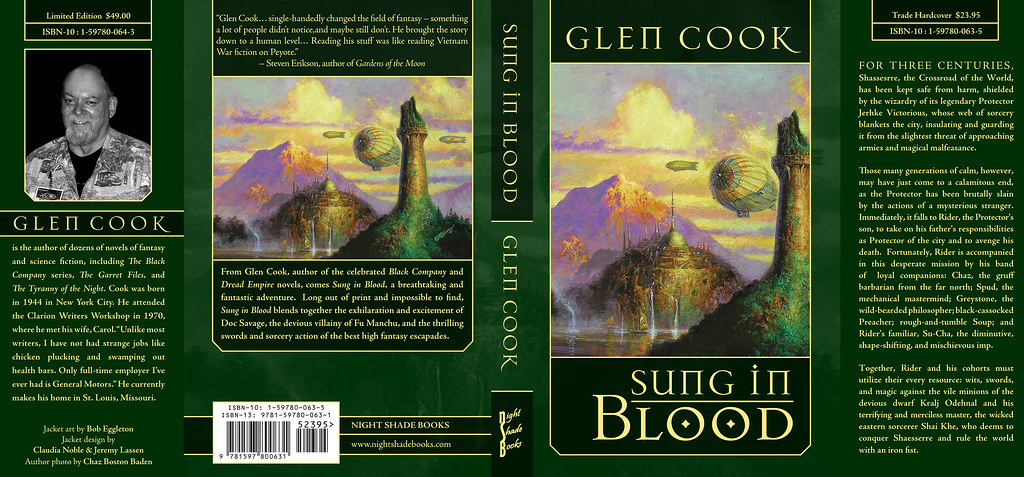
 But with so many free books, the only book I actually bought myself all weekend was Glen Cook's Sung in Blood, brought back into print by the wonderful guys at Night Shade Books, which I have wanted ever since I saw the gorgeous cover by Bob Eggleton on their website. (Check out the full jacket spread!) Jeremy and Jason have been doing good work for a long while now, but they seem to have really taken it to the next level somewhere in the last year, an observation that is brought home every time I see their table display at a convention. I find myself drooling at a dozen recent titles and going "I want! I want!" This is in part due to the caliber of works they have begun to put out, but also due to the amazing efforts of their new designer Claudia Noble. Whatever the reason, the end result is that I am just so impressed with their line these days. Meanwhile, I've never read Glen Cook before, so the fact that Sung in Blood is a slender volume means I actually stand a chance of discovering a new (to me) author and reading it before Hell freezes...
 But with so many free books, the only book I actually bought myself all weekend was Glen Cook's Sung in Blood, brought back into print by the wonderful guys at Night Shade Books, which I have wanted ever since I saw the gorgeous cover by Bob Eggleton on their website. (Check out the full jacket spread!) Jeremy and Jason have been doing good work for a long while now, but they seem to have really taken it to the next level somewhere in the last year, an observation that is brought home every time I see their table display at a convention. I find myself drooling at a dozen recent titles and going "I want! I want!" This is in part due to the caliber of works they have begun to put out, but also due to the amazing efforts of their new designer Claudia Noble. Whatever the reason, the end result is that I am just so impressed with their line these days. Meanwhile, I've never read Glen Cook before, so the fact that Sung in Blood is a slender volume means I actually stand a chance of discovering a new (to me) author and reading it before Hell freezes...
Finally, Sunday night was a dinner with Mike & Linda Moorcock, John Picacio, Chris Roberson & Allison Baker. I've known Michael professionally via email and phone for 5 years now, but haven't been in the same city with him since we first started working together, so it was nice to actually sit down and talk without technological aid. Had a delightful dinner, and he handed over the hardcopies of some of the stories we're aggregating for The Metatemporal Detective, but after dinner was a bit of an unexpected kick. Now, I read his Eternal Champion stories obsessively when I was a pre-teen, but Mike is Mike and I'm not a drooling fan boy, right? Only we finish dinner and he says, "Oh, Lou, I've got Stormbringer in the boot of the car if you'd like to have a look. I didn't bring it in because I didn't think they'd want us swinging it around in the restaurant." Turns out that a European armory made a few hundred limited edition swords with his blessing and consultation, which all sold for around US $8,000 each, and Mike has the prototype. So in the street outside the restaurant, I swung a four foot black broadsword by its two-handed jewel encrusted and talon-clawed grip. I don't geek out for much these days, but this was some powerful childhood mojo in the palm of my hand(s), let me tell you. Hardest thing I did all weekend was giving it back. Roberson got a little close too, so apologies to his family if he's not the person he was last week. If you know what I mean.
But all good things must come to an end, mustn't they? For my part, the con ended on Monday morning with breakfast burritos and good conversation from Elizabeth Bear, she who embodies the combination of intelligent opinions and genuine warmth which underscore perfectly what makes the WFC community such a wonderful place to be. And thanks to the free copies in the aforementioned tote bag, I had plenty of reading on the plane home. (Aside: why do you say "on" the plane and not "in" the plane? Because I'd much rather ride in a plane than on it.) But on the way back I read two selections from Cross Plains Universe, Chris Roberson's "The Jewel
 of Leystall," which takes place in the counter Earth of his recent novel Paragaea, and Michael Moorcock's "The Roaming Forest," one of his tales of Rakhir the Red Archer. I also read Paolo Bacigalupi's "Pop Squad," a novelet in the Oct/Nov issue of The Magazine of Fantasy & Science Fiction. A chilling tale in the tradition of Fahrenheit 451 and Logan's Run - the sort of dystopian narrative where a protagonist policeman who previously hasn't questioned his society wakes up to the knowledge that he is doing very bad things - the novelet is screaming for a Hollywood option and subsequent screenplay adaptation. I am not kidding. This one has "film me" written all over it. In a good way.
And now I am home, still playing catch up on Wednesday morning, with a long con-less stretch of months ahead of me, way too many manuscripts in my submissions pile, and, thanks to such a stimulating weekend, oh so many plans.